Connect with me

How to install JDK on Windows 11
Learn how to install JDK on Windows 11 using the ZIP file from java.jdk.net. Learn manual JDK setup, environment variables, PATH configuration, and version verification.
Connect with me


Learn how to install JDK on Windows 11 using the ZIP file from java.jdk.net. Learn manual JDK setup, environment variables, PATH configuration, and version verification.

The Chain of Responsibility design pattern enables multiple objects to handle a request sequentially, reducing tight coupling and improving flexibility by allowing requests to pass through a configurable chain of handlers.

The Bridge Design Pattern is a structural pattern that decouples an abstraction from its implementation so that both can vary independently. It is commonly used when a class grows in two orthogonal dimensions and inheritance alone cannot prevent the explosion of subclasses.

The Flyweight pattern is one of the most resource-conscious patterns in existence. While the Singleton pattern was created to ensure a single instance of a class exists, the Flyweight pattern was created to handle millions of instances without crashing your memory.
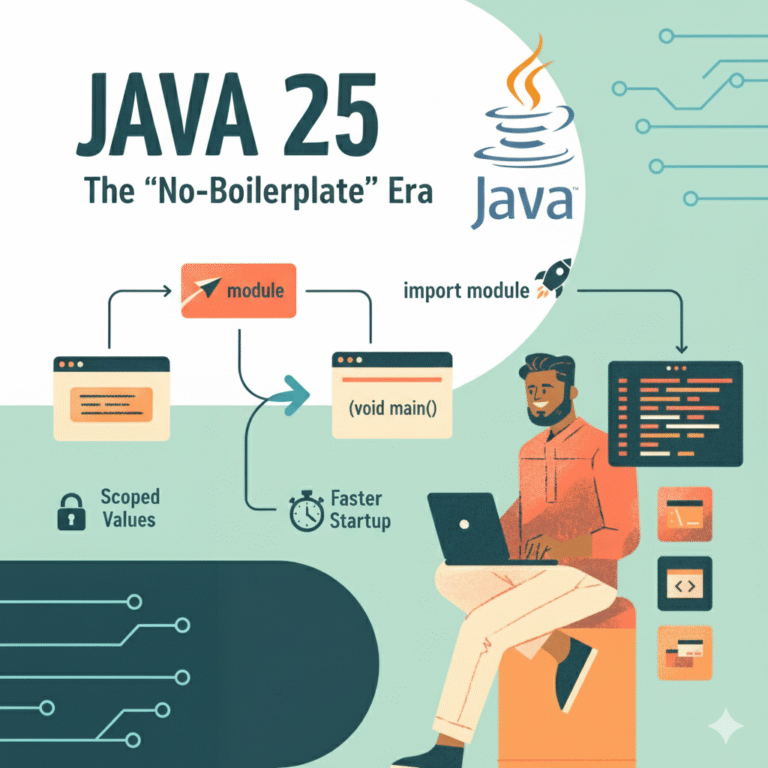
Java Latest Version JDK 25 has arrived, marking a massive milestone for the Java platform! As a Long-Term Support (LTS) release, JDK 25 finalizes many of the features we've been experimenting with in preview modes, while introducing powerful new runtime optimizations.

The Decorator Design Pattern allows us to attach additional responsibilities to an object at runtime while keeping the original object unchanged. In other words, the pattern promotes flexible behavior extension without subclassing.

The Proxy pattern provides a substitute for another object, controlling access and allowing additional functionality before or after requests reach the original object; useful for lazy loading, security, and resource management.Retry

The Facade Design Pattern simplifies complex systems by providing a unified interface. It hides intricate operations behind a clean layer, making code easier to use, maintain, and extend without exposing internal details.

The Composite Design Pattern allows objects to be organized in a tree hierarchy, enabling uniform treatment of individual and grouped elements.

Adapter pattern enables integration of new interfaces with existing implementations, allowing reuse of legacy code without rewriting them for newer interfaces.

The Factory pattern is the second most commonly used design pattern. It is based on the idea that we can create objects of a common super type, while allowing their actual implementations to differ in subsequent subclasses.
The Prototype Design Pattern is a creational pattern that lets us create new objects by cloning existing ones instead of instantiating them from scratch.